GARAGE SALE TIPS | CASH IN ON THE CLUTTER

Garage sales are a lot of work, but they can also be quite profitable! Read on for tips on hosting a successful garage sale and maximizing the profit from items you no longer need.

curbside deals

Our family has been busy the last nine months decluttering our rental house, in preparation for our big move to our forever home, Arrow Hill Cottage. Through this process, we have come across many items that, although in great shape and of good quality, we don’t plan to bring with us when we move.

Faced with the decision of what to do with these unwanted items, we have a few options. Throwing, donating, or selling.  While there were a few broken things that made their way to the trash bin, ultimately we much preferred to get the quality merchandise into the hands of people who could use it.


IS A GARAGE SALE RIGHT FOR YOU?

There are a variety of reasons you might question if a garage sale is your best option. Weighing the pros and cons can help you make the decision more easily. Start by asking yourself the following questions:

Do I have enough to sell?

If you have only a couple boxes of items to sell, it may not be worth the hassle to set up a sale. Consider instead placing an ad on social media with descriptions and pictures of the items you have available. You may have better luck pin-pointing buyers in this fashion.

Are my items current?

Decluttering storage closets and other rarely looked at spaces in your home may yield items that are many years old. Although clothing and home decor styles do tend to eventually cycle back around, it is possible that the items you have been holding onto are no longer desirable to others at the current point in time. If so, donating might be your best option.

sorting through the clutter

Is my location appropriate?

You might have a house-full of good, quality items. But, with a poor sale location, you could struggle to find paying customers. A garage sale set at a remote country house off of a gravel road might not be as successful as one in a quiet city neighborhood, for example.


PREPARING FOR A GARAGE SALE

If you answered ‘yes’ to the above three questions, chances are you will be able to have a successful garage sale! With the proper preparations, your sale can be the go-to place for good deals.

Months before the sale

Begin sorting through your sale items early. We found it helpful to declutter our entire home before our sale. Every room, closet, and cupboard was scoured. This ensured that everything we wanted to sell was available to our customers. And once these items were out of our house, we knew they wouldn’t be coming back in!

Ask relatives or friends if they would like to go in on the sale with you. Sometimes, advertising a ‘multi-family’ sale can draw a larger crowd.


The week before the sale

Allow yourself enough time to clean and organize your garage in preparation. Take extra care to cover any items that are not going to be included, to avoid sale-day confusion from customers.

Borrow long tables if needed. The more organized the setup is, the easier it will be for people to find the things they might be looking for.

Price the merchandise. In the past, I have hosted fundraiser garage sales, where none of the items for sale had price tags. Customers were asked to simply make a donation of any amount. If you have a specific cause that people feel passionate about donating toward, you may do well without price tags. However, as a general rule, most shoppers prefer to know upfront how much you expect for each item. Price tags can help customers avoid confusion.

Think about advertising. If you plan to place an ad in a local newspaper or shoppers guide, be sure to contact them early enough. One week ahead of the sale is usually sufficient.

pricing garage sale items


The day before the sale

Prepare the money box. Starting the day with sufficient change is a good idea. For our sale, we used the guidelines from bizfluent to set up our cash box. Within the first two hours of the sale, we were able to take our ‘seed money’ out of the box, for safe keeping.

Create clear signage. It’s a good idea, even if you took out an ad in the local paper, to place signage the day of the sale. They can help direct customers who might be looking for your sale, and also draw in a few others! The night before the big day is the perfect time to whip up those signs. Be sure to use large, block letters that can be clearly read from cars driving by. Place them at popular intersections, and along the road. Adding streamers and balloons can also be effective!

Consider supplemental advertising. If your community or neighborhood has a way to digitally advertise, such as through a group Facebook page, or Craigslist, take advantage of the free publicity. At least half of the traffic to our garage sale came from an ad I posted on Facebook Marketplace the night before.


EXTRA GARAGE SALE TIPS

Through the years, we have hosted quite a few garage sales. Some more successful than others. These are the things we have learned that have helped us run a smooth and successful sale.

Set a goal

If your family has a specific goal that the garage sale proceeds will go toward, it may motivate everyone to declutter as much as possible. The money earned from our latest garage sale will be applied toward a sectional sofa for our new home’s family room. Anticipating a family movie night together was a huge motivator for all of us.

Price in quarter increments

It can be stressful trying to make change for a fifteen cent item. Speed up the process by pricing everything with the basic quarter in mind. Twenty-five cents per book, or four for a dollar, for example. It’s easy for the customer, and easier for the cashier!

shopping at a garage sale

Allow bulk deals

If you have a large amount of any one type of item, consider allowing a bulk deal. We have had a lot of luck selling bags of clothing for three dollars apiece. Knowing they can buy each piece of clothing for fifty cents, OR spend three dollars on an entire bag, customers might choose to bring home more.

Last minute sales

For the last hour of so the sale, when you want to get the garage cleaned out, allow greater discounts. Everything half priced or ‘make an offer’ are a couple of ideas that have worked well for us.

After the sale

Once the garage sale has ended, you may find yourself with quite a bit remaining. I will usually try to sell the high quality items through Facebook Marketplace. Remaining items can then be donated, or offered for free curb-side.

big sale to cash in on the clutter


OUR CLUTTER TO CASH TRANSFORMATION

Our most recent garage sale was a major success. With the clutter now out of our house, and the cash in our pockets, we are ready for our move! Watch the video to find out how much we earned!


TIPS FROM OTHERS

Everyone has different ideas about how to plan for and run the best garage sale. Consider checking out the tips from these other bloggers for more ideas on how to cash in on your clutter.

Yard Sale Queen

Money Crashers

Frugal For Less


PIN THESE IDEAS

garage sale tips for a successful sale


Money Saving Tips for families

Raising a family is difficult enough without having to worry about money challenges. Today I share the money saving tips that our large family uses to relieve the pressures.


important money saving tips for families

We are a fairly frugal family. In part, because, for many years we have relied solely on one income for our day to day expenses. My husband has been the primary bread-winner for our family. Any additional money that I am able to bring in, through designing homes or other various small business ideas, has always gone toward debt payment. Or, applied to any ‘extras’ that we are saving up for, such as Christmas gifts.

This financial set-up has allowed us a lot of flexibility. I have been able to be a stay at home/ work from home mom for over twelve years now. It has also meant that we need to be very careful with how each dollar is spent. We are big believers in the importance of following a budget, which I will discuss a bit later in this post.

First though, I want to share with you some of the most effective money saving tips that our family uses, to live on one income comfortably.


CUT THE CORDS

Technology really seems to be king, and they know it! They like to lure you in with introductory prices, and then increase your rates once you have gotten comfortable. Advertisements from technology companies leave you feeling that you need their products, when in reality you may not.

Cable tv

One of the first large sacrifices that we decided to make was to eliminate cable tv. We found that, out of the two hundred plus channels offered with our cable package, we watched only a handful. Instead, we switched to Netflix, which is just a fraction of the monthly cost. An added bonus is that there is a huge variety of kid programming, which allows our children to access their favorites whenever they want, and without the need for a dvr.

Cutting cable is a quick way to save money when raising a family

The blog Young House Love wrote a wonderful article about how they cut their cable tv. They tried out a variety of alternate options and compared them. If you are considering making the switch away from cable tv, I highly recommend you read this post.

Phone

We also cut our phone cord. It seemed to us that most of the calls we were getting on our home phone were coming from telemarketers or people who dialed the wrong number. Switching to a ‘home’ cell phone was our solution. When people ask us for our home phone number, we give them the number of that cell phone and nobody is the wiser.

This setup will be even more useful when our oldest son begins driving or attending activities away from home. We can simply hand him this dedicated cell phone to use, instead of getting him his own plan.


EAT AT HOME

Eating out is ridiculously expensive. Once the tip is added in, a sit down restaurant meal for our family can easily top one hundred dollars. Considering a weeks worth of groceries for our family of seven is just slightly over one hundred and twenty five dollars each week, eating out doesn’t make any sense at all. One of my long term goals for Arrow Hill Cottage is to grow a large portion of our own food, and learn how to preserve fruits and veggies through canning.

Meal planning

We have been following meal plans for a couple of years now. I started out with a four week rotation, then added a couple extra weeks into the mix, for variety. I have plans to feature my favorite recipes on the blog, complete with a video tutorial of each meal, so be watching for that!

Learn how to cook healthy meals for your family to save money


Pack lunches

School lunch is another area where a lot of money can be saved. At our kid’s school, a meal is just shy of three dollars. Multiply that times five kids, and just one week of meals can run up a seventy-five dollar bill! Because of this, I am sure to pack lunches for our kids a majority of the time.

The rule at our house is that each child is allowed to pick their two favorite meals each week, to eat from the cafeteria. The remaining meals are brought from home, and the kids have a hand in picking out what goes into the lunch boxes. We also tell them to bring home whatever portion of their cold lunch isn’t finished at school, so that they can use that food as an after school snack. Less food waste means money money in our pockets!


BUY SECONDHAND

There is a thrill in buying a brand new item, sure. But, generally speaking, you aren’t likely to be getting the best value for your money by making this type of purchase all the time. In fact, one of the best money saving tips that I can offer is to buy items secondhand whenever it is feasible.

Vehicles you can afford

Surely you already know that new vehicles go down in value as soon as they leave the sales lot. And, besides your home, the vehicles you purchase for your family might be one of the largest purchases you will ever make. Because of this, it is very important to find a good deal.

Buying used can sometimes have a stigma; But I highly doubt that many people could spot a used, four year old vehicle over one that is brand new, just by looking at it.

Shop used items

Shopping at second hand stores for household items, clothing, and toys can also save a lot of money.

Purchasing clothing second hand is a great money saving tip for families

I firmly believe that second hand stores have really upped their game in recent years. Generally, they do a good job of screening broken, stained or blemished items. Those that make it to the store shelves have a lot of life left in them.

You can find some real treasures, and save a bundle!


DO IT YOURSELF

You can save your family a lot of money by learning to do things by yourself, instead of calling somebody to do the job for you. With online access, tutorials for just about everything can be found. From small car repairs to craft projects, a video reference is likely available.

Even basic daily chores, done yourself, can save you money. Simple tasks that we personally take on ourselves include mowing our own grass and washing our vehicles by hand, instead of going through the car wash. I also learned how to cut hair, which saves us at least $80 per month.


VACATION NEAR HOME

Family vacations, though wonderful for creating memories, can really put a dent in your pocket book. Instead of spending a ton on airfare, lodging, and restaurants, consider vacationing closer to home.

When saving money as a family, one tip that can save is to vacation closer to home

For example, we live in Minnesota’s lake country but personally do not live on a lake. Our kids are just as thrilled to stay the weekend at a local lake cabin as they would be to travel to Disneyland. Being able to play on the beach and put our toes in the sand is a change of pace for all of us, even if the location to home is close.


ELIMINATE THE EXTRAS

If you are looking for a place to start for a quick money saving win, this is it. An extra is anything that you use to treat yourself on a regular basis, or something that you don’t use often but like to have available.

Though they aren’t typically large expenses, put together they tend to add up. For example, that morning coffee that costs close to five dollars at the posh coffee shop, could be replaced for a much more budget friendly home brewed cup.

Memberships

Memberships can be particularly luring because they offer up a convenience factor. Consider if you make it to the gym often enough to justify the monthly price you are paying, or if you could stay fit by working out at home.

Do you need the weekly food prep service delivered to your door, or would an effective meal plan do the trick?

Entertainment

Many people don’t think about the free forms of entertainment that are available. The library not only loans out books, but music cds and movies as well. Consider borrowing something for free every once in a while, instead of always rushing to the theater each time a new film comes on the big screen.

Take in the public park in lieu of paying an entrance fee to an amusement park or museum.


RESEARCH SPLURGES

There will definitely come a time when you will be purchasing big ticket items such as a new television, furniture piece, or appliance. These purchases should not be taken lightly, as they should be considered as an investment item.

Talk with friends who have recently purchased similar items and ask their opinions and recommendations. Do a bit of online research with company such as Consumer Reports.

It is also important to note that certain items do tend to go on sale certain times of the year. Find out when the sales happen, and save yourself some money!


JUST SAY NO

This might not be a popular tip to discuss, but it is very important. Saying no to ourselves seems to be particularly difficult, as it makes us feel as if we are denying ourselves of something we deserve. In reality though, by making a foolish purchase you could be denying yourself financial stability.

Don’t use credit

It is as simple as that. It is just too easy to buy something on credit with the intention to pay it off. And maybe most of the time you are able to do that. But what happens if there is an unexpected event that prevents you from doing so. The interest rates are going to bite you, and make you wish you had never made the purchase in the first place.

Don’t let yourself get into that type of situation. When you use the money that you actually have to buy what you need, you can feel confident that it won’t break you.

Say no to making purchases you can't afford. Money saving tips for families

Stay out of stores

With almost one hundred percent certainty, I can predict that if you walk into a store to ‘just window shop’ , you will walk out of it with something you didn’t actually need. I know this is true, because it happens to me all the time!

When we had our month long No Spend Challenge, our eyes were opened to this phenomenon. By simply staying out of the stores entirely, we saved quite a bit of cash.


To kids

Sometimes saying ‘no’ also means saying no to our kids. Whether it is them asking for another toy, or wanting to sign up for an event, remember that it is your money that you are using. All the final decisions of where it goes will rest on your shoulders.

Likewise, don’t feel as though you need to sign your child up for expensive activities just to keep them busy or give them a chance to meet friends. If they aren’t that into it, it’s okay to skip.

For example, our oldest son was involved in soccer as a third and fourth grader. By the summer of his fifth grade year he was eligible for the traveling team. The cost of this program was two hundred and fifty dollars, and would require that nearly every weekend of the summer would be spent on the road in attendance of a game. We asked him if he loved soccer enough, to make that large of a commitment (both in time and money). He told us no. Kids are smart.


USE A BUDGET

If you get nothing else from this list of tips, please hear this. Budgeting is so, so important. Sure, it isn’t the most fun thing to do in the world, but it will make a world of difference.

We have used a budget for well over ten years, and I honestly don’t think it would be possible for me to go without one at this point. It is so helpful to not only see how much money we have to work with each month, but also to track our spending as the days go by. If we find ourselves overspending in one category month after month, we can re-evaluate the situation and determine if we have been foolish, or if that category needs to be beefed up.

Personally, I love the Everydollar budgeting software and app, which are both free! There are plenty of other popular and well respected options though, such as YNAB (You Need a Budget) and Mint. Check them each out, and determine which is a good fit for your family.


MONEY SAVING TIPS VIDEO

Listen to me discuss our families most successful money saving tips.


SAVE THESE TIPS

If you are looking for ways to cut everyday costs, and boost your savings, be sure to pin these money saving tips!

Money saving tips for families wanting to live on one income


NO SPEND MONTH | UPDATE + TIPS

In this post, I discuss important tips for a successful no spend month. Our family just finished one and, although there were some big challenges, it was a great learning experience.

no spend month review and tips on how to do it successfully

I spent the month of January, along with my friend and fellow blogger Shannon Torrens, focusing on not buying anything new. It was a logical step to take, while we work on decluttering our rental house – in preparation for our big move. Later in this article, I will give an update on how our month went. First though, I want to encourage you if you are thinking of doing a no spend month for yourself.


TIPS FOR A SUCCESSFUL NO SPEND MONTH

Before you embark on your own no spend month, I recommend that you take into account the following tips.


CHART YOUR TYPICAL EXPENSES

Whether you budget or not, it is going to be important to have an idea about how much you spend in a typical month. This information will be especially helpful at the end of the month, to see how much you saved. Knowing that you are saving money might give you a boost of motivation.

tips for a successful no spend month

In a future post, I will discuss how our family does budgeting using the free app Everydollar. Most of our budget categories don’t change, dollar wise, from month to month. The four categories that are the most variable for our family include: auto/gas, groceries, restaurant, and miscellaneous. Because of this, we chose to chart the expenses for these four categories before going into our no spend month – with the hope that we would see some savings.


SET THE RULES

It is unlikely that anyone’s ‘no spend month’ actually means not spending a single cent. That would be basically impossible. Rent needs to be paid, utilities have to be kept up to date. And, of course, you and your family are going to need to eat. The great news is that you can make up your own rules for a no spend month.

Our rules were pretty simple. You can read about them in this post. Essentially, our main goal was to bring nothing NEW into our home. That meant that we were free to spend money on food and restaurants, if we chose. It also meant that consumable items, such as shampoo and toilet paper, could be purchased.


START WITH AN OPEN MIND

Knowing that you COULD be purchasing something, yet holding back, can be a difficult thing to do. For that reason, I recommend that you think about this month as a learning experience above anything else. An experience that will help you understand your buying patterns.

No spend month tips for success. What we did that worked, and what didn't.

If you start the month simply thinking about all the restrictions that lay ahead, you may find yourself more frustrated than you need to be.

Likewise, it is important to note that things won’t go perfectly as planned. If unexpected purchases arise that you simply can’t avoid, or if you slip up and buy something that you weren’t supposed to, don’t despair. Know that one false move shouldn’t derail the entire plan. In those instances, be prepared to pick yourself up and start again. This is where having an accountability partner is key. They can help you stay on the path to success. Shannon was mine, and it was great to take on the challenge together.


OUR NO SPEND MONTH

As I mentioned earlier, during the month of January, our family worked hard to not spend any money – specifically on any new THING. There were a few hiccups along the way, but ultimately we learned a lot of useful information about our spending habits.


WHAT WENT WRONG

Starting this challenge on the first of January seemed to be a logical choice. With Christmas over, we knew that our expenses would probably be down. In addition, the start of the new year gave us an extra boost of motivation.

Unfortunately, the month of January also brought with it severely cold weather to Minnesota, where we live. And it just so happens that only two days into the challenge, the battery in one of our vans was found dead when we went to start it. Ironically, two weeks later our other van’s battery also needed replacing. In total, we ended up spending over three hundred dollars on replacements.

Though it wasn’t fun dealing with those unexpected expenses, the batteries were indeed necessary. And delaying the purchase of them was not an option.

I also had a minor purchase slip up. A friend of mine started selling handmade watercolor paintings, and I purchased one for the girl’s bedroom. It wasn’t until after I sent her the money that I remembered that this would be considered a breech of the rules. Thankfully, she was kind and told me she would hold onto the art piece until the challenge was over – as not to add an extra item to the house.


WHAT WENT RIGHT

From the start of the month, we kept a record of any item that was a potential purchase. It was our intent that we would keep the list, to make the purchases in February. Interestingly though, quite a few of those items ended up getting crossed out. We either realized we didn’t actually need them, or found something similar that could be used in it’s place!

No spend month. Spending freeze


We were very careful to stay out of the stores. I actually think that is one of the biggest keys to success during a no spend month. I typically have a habit of going into one of the big box stores for one of two consumable products, and then becoming distracted. Suddenly, I find myself leaving the store with quite a few unnecessary items. During the month of January, I am happy to report that I did not enter Target a single time – and Walmart only once!


Even the kids got in on the action. They had received gift cards from family at Christmas. While normally they would be begging us to take them to the stores, this time they were much more patient. They recognized that we were holding off on making purchases and figured they could too.

In fact, when the month was up we went into the stores to do a little window shopping. Only one of our five kids ended up making a purchase. The rest decided to save the money for something they really want. It made us happy to know that the no spend month was a great learning experience for them as well.


THE BOTTOM LINE

If you have read this far you may be asking yourself one question. How much money did you save? Because we tracked all of our expenses, I am able to break that all down for you!

Essentially, we were looking at our four most variable categories: auto, groceries, restaurants, and miscellaneous. Here are the details on how the month of January compared to an average of the three previous months (December, November and October).


AUTO

As mentioned earlier, this budget item was most affected. Those two car batteries were large ticket items we definitely weren’t looking at spending money on.

Tips for a successful no spend month

Auto budget average over past 3 months: $202. Amount spent in auto budget during January: $468

That means that we overspent in this category by about $266. A bummer, yes. But like I mentioned, they were necessary purchases. The good news is that the batteries are high quality, and should last for quite a while.


GROCERIES

Our grocery amount stayed pretty consistent throughout the no spend month. One thing I did try to do was use up pantry items and canned goods. In the end, we were ahead in this category only slightly.

Grocery budget average over past 3 months: $815. Amount spent on groceries during January: $790.

A tiny savings of $25 in this category.


RESTAURANTS

Because we have a large family, we tend not to eat out very often. It is just too expensive. One meal out can be over one hundred dollars easily. That being said, we do enjoy the occasional treat night out and do keep a line item in our budget for restaurant expenses.

Our no spend month update. How it went, and how you can be successful

Restaurant budget average over past 3 months: $146. Amount spent on restaurant food in January: $130

Another tiny savings of $16.


MISCELLANEOUS

This is the meat and potatoes portion of this challenge. Where the other categories do not typically involve ITEMS to purchase, this category has a lot of wiggle room. The miscellaneous budget includes toiletries, clothing, kid field trips, and a whole slew of other things. It is the category that has the most grey area, and the budget item that gets the most abuse each month if we aren’t careful. It is easy to overspend in miscellaneous.

I was happy to see that making more intentional purchases really made a difference in this category during our no spend month.

Miscellaneous budget average over past 3 months: $890. Amount spent on miscellaneous items in January: $330.

That is a HUGE savings of $560!


With all the categories added together, we ended up saving $335 during January, simply be being more mindful of our purchases. In our household, that is a big chunk of change!


GOING FORWARD

We had friends who wondered if taking on a no spend month would simply result in a spending binge directly afterwards. In effect, erasing any progress that was made.

At fifteen days post challenge, I have definitely seen a more relaxed feeling around spending. However, our resolve to be more intentional is still going strong. We were never looking at this experiment as being a one and done event. Rather, we felt that the no spend month could be a jump start to a life long habit. As with any new habit, it will take a while to figure out what works best for us.

We will continue to keep a list of potential purchases, and waiting a few days or even a few weeks before committing to them. I also plan to be careful about sticking to the shopping list when entering those big box stores!


PIN THESE NO SPEND MONTH TIPS

If trying out a no spend month is something you are interested in, be sure to save these tips! I definitely encourage you to give it a try!

no spend month challenge. tips on how you can be successful


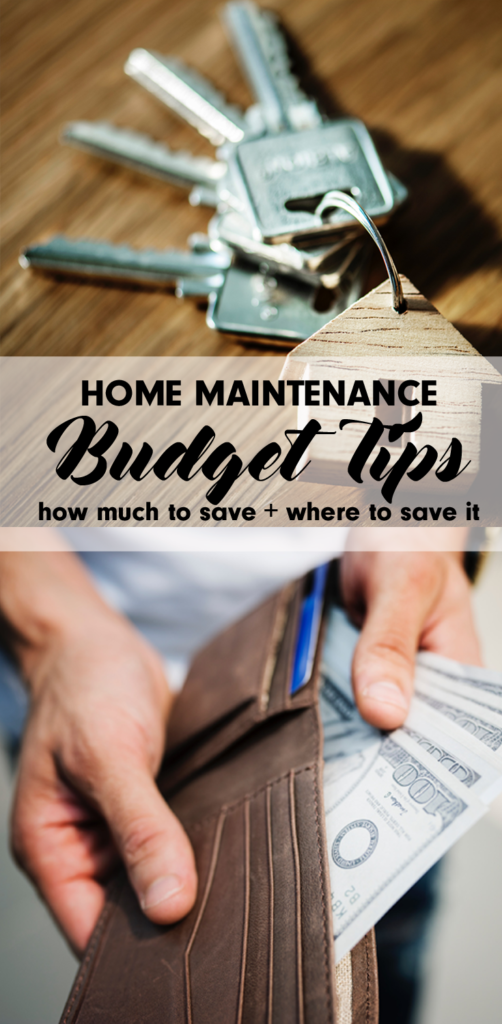
HOME MAINTENANCE BUDGET TIPS

Anyone who owns a home knows for certain one fact: THINGS WILL BREAK. And unlike renters, homeowners need to be able to pay for the repairs out of their own pockets. Because of this, it is wise to have a home maintenance budget in place.

home maintenance budget ideas

Issues may be a minor patch jobs that can be done over a weekend. Or there may be extensive damage that requires the expertise of a seasoned professional. The tricky thing is, you never know which kind will pop up, and/or how much these fixes may cost.

It is very wise to be prepared upfront, but starting a home maintenance budget. The following tips can help you determine how much to save, and where to keep the funds for the inevitable ‘rainy day’ when they will be needed.


TIP #1: THE ONE PERCENT RULE

budgeting for home maintenance

If you have just moved into your home, and have yet to repair anything, you may want to start with this rule. Use the purchase price of your home as a guide, and save 1% of that figure for repairs. If you purchased your home for $250,000, for example, expect to save $2,500 per year for maintenance.


TIP #2: THE SQUARE FOOTAGE RULE

home maintenance

Another easy calculation is to save $1 per square foot per year. If your home is 1,500 square feet – that would equate to $1,500 available for repairs each year.


TIP #3: CONSIDER THE AGE OF THE HOUSE

home maintenance budget amounts

Obviously, a newer home should need less maintenance than one that is older. In the first 5-10 years after a home is built, there should be only minor repair needs. Between 10 and 20 years, common maintenance includes re-painting, window replacement, and flooring removal/replacement. Homes that are over 30 years are more of a challenge. Major systems such as the roofing, electrical, and plumbing-  may begin to fail.

A graduated savings plan might be a good idea. Save a smaller amount of money each year for the first 10 years and increasing the amount put into the account as the house ages. Any money that isn’t used in the early years can be applied to the more costly repair items that inflict a home in it’s later years.


TIP #4: CONSIDER THE CLIMATE THE HOUSE RESIDES IN

amount to save for home maintenance budget

Houses located in areas of the country that receive freezing temperatures, large amounts of snowfall, and ice storms are more susceptible to exterior damage.

Houses located in areas that receive heavy annual rainfall and humid summer months can be subject to termite damage, which can weaken the wooden structure.

If you live in one of these areas, it is a good idea to pad your savings a bit.


TIP #5: CONSIDER PRIOR  + FUTURE MAINTENANCE

maintenance and repair budgeting

Small problems will become larger ones if left unattended. It is important to keep on top of the small issues as soon as they are discovered.  If you aren’t the first owner of your house, you may have inherited unresolved issues that are beginning to turn into big problems. A house that has had poor past maintenance is going to require a heftier savings for repairs.

On the flip side, the previous owners may have done a great job keeping the house maintained. If this is the case, you will be able to primarily focus on future repairs.

Not all repair and maintenance items are surprises. Be sure to consider what ELECTIVE projects you plan to tackle in the future. Do you dream of a brand new kitchen or hardwood floors throughout? Go ahead and beef up your fund to reflect these improvements.


TIP #6: KEEP THE MONEY LIQUID

home maintenance budget tips

Once you determine the amount you will be saving for your home maintenance and repair, you need to decide where to put the funds.

The primary thought is that this money should be available, yet forgotten about. For example, keeping the funds in the standard checking account might not be the best idea. They will be more susceptible to being used for not house-related items.  Converting the cash into savings bonds is also not ideal, as they can be more difficult to access when the need arises.

A money market account may be able to get you a bit of interest over time, but also has the disadvantage of losing value if the money needs to be pulled out at a low point in the market.

The best approach is to set up a separate savings or checking account that can be linked to your primary checking. When maintenance costs are incurred, you can easily move funds from savings to checking in order to pay the bills.


Use these tips to determine how much money to save, then be diligent to do just that! Having a home maintenance + repair budget isn’t the most glamorous thing you can imagine doing with your money, but it will give your family a sense of peace knowing that if a problem arises it can be easily taken care of, without a financial burden.


PIN THESE IDEAS FOR LATER

home maintenance budgeting tips